Using Augmented Reality in the classroom allows for students to be able to visualise and understand how something may fit in that particular environment or setting and even create their own environment with a variety of different applications that are available online and also on many smart devices. The use of Augmented reality allows for students express their creativity by creating various things for the use of augmented reality and it also helps students learning as different applications and specifically made educational tools such as books integrate the use of augmented reality so that students are able to see models of objects and vehicles that would otherwise be unattainable or unrealistic to see in person.
Augmented reality is used in a classroom setting and helps students to engage in authentic explorations in the real world and it also allows for observation to be created that cannot easily be observed with the naked eye by displaying virtual elements alongside real objects (Prodromou, 2020). By implementing Augmented reality in everyday teaching activities it allows for students to be more motivated to participate more actively rather than just rote learning and thereby creates hybrid learning environments that combine digital technology with physical learning utensils henceforth fostering a creative learning space that brings out the creative nature in primary aged students (Prodromou, 2020).
Augmented reality is used by Curiscope that developed the Virtuali-Tee. The Virtuali-Tee combines the use of technology and a t-shirt to demonstrate the anatomy of the human body. As seen in figure 1.1 it shows how the pattern on the Virtuali-Tee is similar to a QR code and can be read by the Virtuali-Tee app and allows for exploration of human anatomy, this provides a fun and interactive way for students to get involved in biology and understanding the human body furthermore, it allows for a more creative way for students to learn as they can explore particular arteries and organs within the Virtuali-Tee application. With the use of the Virtuali-Tee application they are also able to see the finer details of particular organs and arteries as well as systems of the body such as the nervous system. This allows students to have a deeper knowledge of the internal sytems of they human body and the level of interactivity that Virtuali-Tee allows is great for student engagement and fostering creativity in their work.
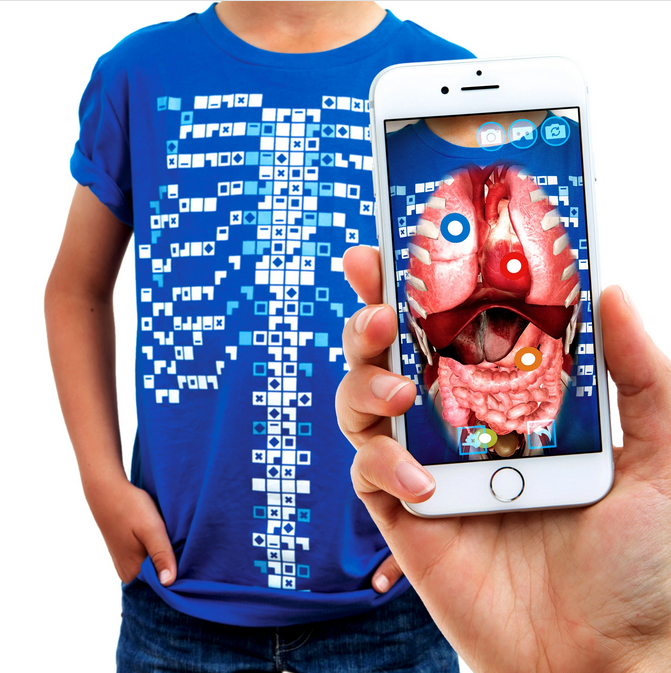
Prodromou, T. (2020) Augmented Reality in Educational Settings.
 EDUC3620 Digital Creativity and Learning
Hi Dean,
After reading your blog, it is great to gain more information about how Augmented Reality can be used in a classroom. and how it can foster students’ creativity and motivation. Thank you for sharing the Virtuali-Tee to us. I can see that it is an effective application for students to learn the human body and be more engaged in learning.
However, maybe try to write about another AR application to make a comparison and show more potentials of AR technology in education.
Thank you!
LikeLike